
A ring can symbolize a lifetime, but its story begins long before the proposal. For couples who want exceptional sparkle without questions around mining, labor practices, or an inflated diamond markup, the question is simple: are moissanite rings ethical?
In most cases, moissanite is a more ethical choice than a traditionally mined diamond. It is lab-created, conflict-free by nature, and produced without the large-scale earth extraction associated with mined gemstones. Still, an ethical ring is about more than the center stone. The metal, manufacturing standards, supply-chain transparency, and the way a piece is made all deserve a place in the conversation.
Are Moissanite Rings Ethical Compared With Diamonds?
Moissanite used in jewelry is created in controlled laboratory settings. While natural moissanite exists, it is exceptionally rare and not practical for commercial jewelry. The brilliant stones seen in engagement rings, wedding bands, and fine jewelry are grown using advanced technology that recreates the conditions required to form silicon carbide.
That origin changes the ethical equation. A lab-created moissanite stone does not require an open-pit mine, underground excavation, or the displacement of communities to reach it. It also avoids the historical concerns that have surrounded parts of the mined diamond trade, including conflict financing, unsafe working conditions, and limited visibility into labor practices.
“Conflict-free” should never be treated as a decorative label. With moissanite, the claim is grounded in the material itself: it is not mined from regions affected by gemstone-related conflict. For many couples, that means the ring on their hand can represent love and intention without carrying the uncertainty that can accompany a mined stone.
This does not mean every mined diamond has the same history, or that every lab-created product has no environmental footprint. Ethical sourcing is rarely a one-word promise. But moissanite offers a clear advantage because its supply chain starts in a lab rather than a mine.
The Environmental Side of Moissanite
Mining can alter landscapes, use substantial amounts of water and energy, and create long-term waste-management challenges. The impact varies widely by mine, location, regulation, and recovery method, but extraction is inherently resource-intensive.
Lab-created moissanite also uses energy. Crystal growth, cutting, polishing, packaging, and shipping all require resources. A responsible conversation should acknowledge that. The difference is scale and type of impact: moissanite production avoids the physical disruption of mining and generally creates a shorter, more traceable path from creation to finished jewelry.
For a buyer who wants to make a lower-impact jewelry choice, moissanite is often a compelling option. It delivers dramatic brilliance and lasting wear while reducing reliance on newly mined center stones. Choosing a design you will genuinely wear for decades makes that decision even more meaningful.
Durability matters here, too. Moissanite ranks 9.25 on the Mohs scale of hardness, making it exceptionally suited to everyday rings. A stone that can stand up to daily life is less likely to need frequent replacement, especially when set and cared for properly. Its long-lasting beauty supports the idea of buying thoughtfully rather than buying repeatedly.
Ethics Depend on More Than the Stone
A beautiful center stone is only one part of a ring. The setting deserves the same consideration.
Sterling silver, gold, platinum, and other jewelry metals each come with their own sourcing and production realities. Recycled metal can reduce demand for newly mined material, while transparent suppliers can offer greater confidence around refining and manufacturing. Ask a jeweler what metal is used, how it is finished, and whether the brand can clearly explain where its materials come from.
Craftsmanship also matters. A well-made ring with secure prongs, balanced proportions, and a durable setting is designed to stay in your jewelry collection - not become a disposable purchase. The most responsible ring is one that is loved, maintained, and worn for years.
At Henri Carat, moissanite is positioned as brilliance without compromise: diamond-like visual impact, precision-cut sparkle, and an alternative for shoppers who want both style and stronger peace of mind. The point is not to make a ring feel less luxurious because it is a considered purchase. It is to make luxury feel smarter.
What “Ethical” Should Mean When You Shop
Ethical jewelry is not a single certification or a universal checklist. It is a purchasing decision shaped by the values that matter most to you. Some shoppers prioritize avoiding mined stones. Others focus on recycled metals, fair labor, local craftsmanship, lower waste, or a realistic budget that does not create financial pressure at the start of a marriage.
When comparing moissanite rings, look for clear answers rather than vague promises. A trustworthy retailer should be able to explain that its stones are lab-created, describe the ring’s metal and construction, and provide straightforward details about warranties, shipping, and care. Transparency is part of the luxury experience.
It is also worth separating moissanite from imitations that are simply glass or low-grade cubic zirconia. Moissanite is a distinct gemstone with its own optical character, exceptional hardness, and vivid fire. It is not a diamond, and it does not need to pretend to be one. Its brilliance is real, its performance is proven, and its value is part of its appeal.
A Note on Diamond Testers
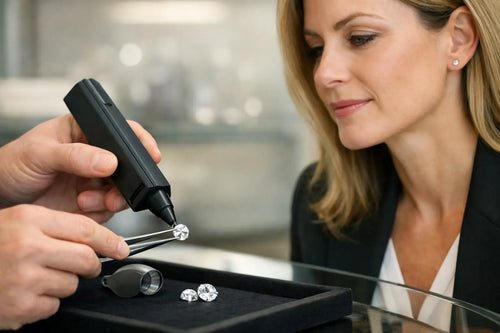
Some moissanite can register on certain diamond testers because of its thermal conductivity. That can surprise shoppers, but it should not be confused with misrepresentation. Advanced testers and professional jewelers can distinguish moissanite from diamond. Ethical selling means describing the stone accurately from the beginning, with no ambiguity about what you are buying.
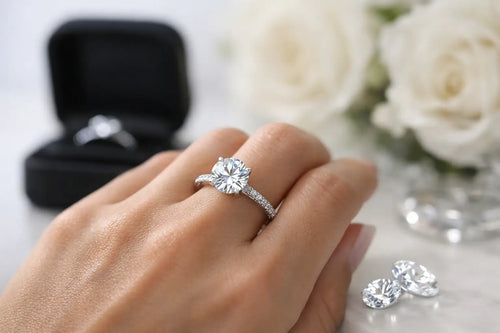
A moissanite engagement ring can look strikingly close to a diamond from across the room, especially in a classic round, oval, cushion, emerald, or radiant cut. Up close, its fire can appear even more pronounced, with flashes of spectral color that create a bold, luminous look. For buyers who love noticeable sparkle, that is a signature feature, not a drawback.
Is Moissanite the Right Ethical Choice for Everyone?
For many people, yes. Moissanite is especially appealing if you want a conflict-free center stone, a lower-impact alternative to traditional mining, and a larger or more intricate design without a diamond-level price tag. The savings can allow room for a more substantial setting, a wedding band, or simply the freedom to celebrate without debt.
But the right choice remains personal. Someone may value the geological rarity and natural origin of a mined diamond, particularly if they can verify its sourcing. Another person may prefer a lab-grown diamond because it is chemically identical to a mined diamond. Those are valid preferences.
The strongest choice is the one made with accurate information. Moissanite should be chosen because you love its exceptional fire, impressive durability, and confident value - not because anyone tells you it is a second-best option. It is a different gemstone with a distinctly modern point of view.
Questions to Ask Before You Choose a Moissanite Ring
Before making your decision, ask how the stone was created and whether the seller identifies it clearly as moissanite. Confirm the metal type, ring sizing options, setting details, warranty coverage, and return policy. If sustainability is central to your decision, ask whether the retailer provides information about its metals, manufacturing partners, and packaging.
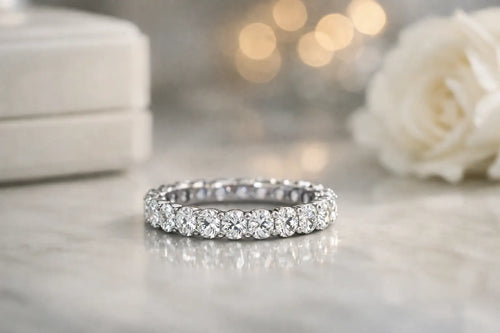
Pay attention to the piece itself as well. A timeless solitaire may be the ethical choice for someone who wants one ring forever. A sculptural halo, an eternity band, or a three-stone design may be perfect for someone whose personal style calls for more presence. There is no virtue in choosing a ring that does not feel like you.
The most romantic jewelry decisions are not made under pressure or tradition alone. They are made with clarity - about your budget, your values, and the kind of brilliance you want to see every time you look down at your hand. A moissanite ring gives that moment room to shine with confidence.