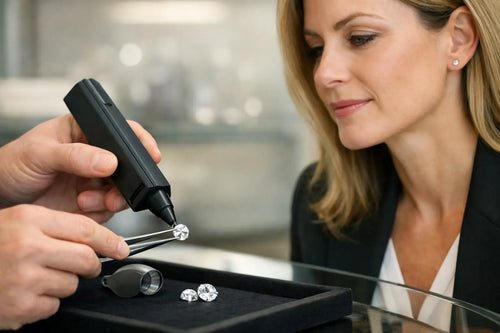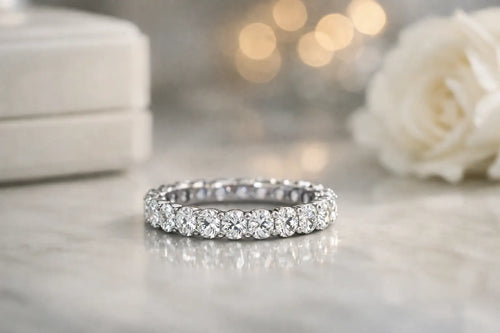

A jeweler touches a small probe to your newly chosen ring, it beeps, and the display says diamond. So, does moissanite pass diamond tester checks? In many cases, yes. That result is not a trick, and it does not make moissanite a lesser choice. It reflects one of the qualities that makes a precision-cut moissanite ring such a striking alternative: its thermal performance is remarkably close to diamond.
For anyone choosing an engagement ring, anniversary band, or everyday statement piece, the better question is not whether a basic tester reacts. It is what that tool is actually measuring, and what it can tell you about the exceptional gem you are wearing.
Why Moissanite Often Passes a Diamond Tester
Most traditional diamond testers measure thermal conductivity - how quickly a stone transfers heat. Diamond conducts heat extremely well, which is why it produces a positive reading on this style of tester. Moissanite also conducts heat at a high rate, so a standard thermal tester can identify it as diamond.
That familiar beep is why moissanite is often described as diamond-tester approved. It is also why a quick countertop test should never be treated as a full gem identification. A basic thermal tester can separate diamond and moissanite from look-alikes such as glass or cubic zirconia, but it generally cannot reliably separate moissanite from diamond.
This is a meaningful distinction when you are shopping. Moissanite is not trying to be glass dressed up as fine jewelry. It is a durable, laboratory-created gemstone with its own impressive physical character, chosen for intense sparkle, beautiful clarity, and a luxury look that makes room in the budget for the life you are building together.
Does Moissanite Pass a Diamond Tester Every Time?
A quality loose moissanite stone will usually trigger a positive result on a conventional thermal diamond tester. Still, the real-world answer can depend on the equipment and how the jewelry is tested.
The tester needs clean contact with the stone. Lotion, dust, moisture, a poorly positioned probe, or a very small stone can affect a reading. Settings can also make testing more difficult when metal prongs sit close to the point of contact. A professional will clean the stone, hold the probe steady, and test more than once when needed.
The age and condition of the tester matter, too. Older or inexpensive devices may give inconsistent results, particularly on tiny accent stones. That is a limitation of the instrument, not a reflection of the stone's quality. When the question is whether a gem is diamond or moissanite, a more advanced tool is the appropriate next step.
Thermal Testers vs. Diamond-Moissanite Testers
Not every tester is designed to answer the same question. Understanding the difference prevents a lot of unnecessary confusion at the jewelry counter.
A thermal tester detects heat conductivity. Because both diamond and moissanite conduct heat efficiently, it may register both as diamond. This is the simple handheld tester many shoppers encounter first.
A diamond-moissanite tester, sometimes called a multi-tester or combination tester, measures both thermal and electrical conductivity. Diamond is generally an electrical insulator, while moissanite has electrical conductivity that lets the device distinguish it from diamond. With a properly calibrated combination tester, moissanite should identify as moissanite rather than diamond.
Even then, professional gem identification is more nuanced than one flashing screen. Some natural diamonds, particularly certain blue diamonds, can show electrical conductivity. Lab-grown diamonds and treated stones may require additional testing as well. A knowledgeable jeweler uses the correct tools, observes the stone, and understands the exceptions behind the result.
What a Tester Cannot Tell You
A positive thermal test does not reveal a stone's cut precision, color, clarity, carat weight, or craftsmanship. It cannot tell you whether your ring is a natural diamond, a lab-grown diamond, or moissanite. It also cannot confirm that every detail in a finished piece matches a listing or appraisal.
That is why confident jewelry buying begins with clear product information, not a single test. Look for transparent disclosure that the center stone is moissanite, along with the qualities that shape its appearance. Henri Carat moissanite is selected for D-color brightness, VVS-clarity beauty, and precision cutting that brings every facet to life.
For a higher-value purchase, keep your order details and any accompanying documentation in a safe place. If you need an independent verification for insurance, resale, or personal reassurance, ask a reputable local jeweler or gemologist to inspect the piece using professional equipment. Honest disclosure is always the standard. Moissanite deserves to be celebrated for what it is.
Why Moissanite's Tester Result Matters to Shoppers
There is a practical reason this question comes up so often. People want a ring that feels undeniably special from every angle - in candlelight, in photographs, across a dinner table, and during the ordinary moments that become part of a shared life. They also want to know that the brilliance they see is backed by real material quality.
Moissanite delivers an extraordinary level of fire, the colorful flashes that appear as light moves through the stone. Its brilliance is equally vivid, often giving a larger center stone a crisp, luminous presence. In a classic round solitaire, an elongated oval, a sculptural emerald cut, or a romantic heart shape, that radiance creates a look with real occasion-worthy impact.
Durability is another part of the appeal. Moissanite is a very hard gemstone, suitable for jewelry worn frequently, including engagement rings. As with any fine jewelry, it should be protected from harsh impacts and cleaned with care. But it is made for a life in motion, not a box saved for rare evenings.
Then there is the value. Choosing moissanite can make a larger visual statement possible without the conventional cost attached to a comparable-looking diamond. That can mean choosing the setting you truly love, adding a matching wedding band, planning the celebration you want, or simply keeping more of your money for what comes next. Looks like a diamond. Priced like a smart decision.
How to Shop for Moissanite With Confidence
Start with a retailer that describes its stones clearly and does not rely on vague language. A trustworthy listing should identify moissanite as moissanite, explain the metal and setting, and provide straightforward policies on shipping, returns, and coverage. A positive diamond-tester reading is an interesting material fact, but transparent specifications are much more valuable than mystery.
Next, choose based on the look you want to wear. Round cuts maximize classic sparkle. Ovals create graceful length on the finger. Cushions feel soft and romantic, while emerald and asscher cuts offer clean lines and a more architectural kind of glamour. The right shape is the one that catches your eye before anyone else's opinion enters the room.
Finally, remember that sparkle is personal. Moissanite often shows more colorful fire than diamond, especially under direct light. Some buyers adore that high-energy flash; others prefer a quieter, icy appearance and may choose a cut and setting that emphasizes broad, elegant facets. Neither preference is more sophisticated. It is about choosing a piece that feels unmistakably yours.
A diamond tester can recognize moissanite's impressive thermal qualities, but the lasting proof is simpler: choose a beautifully cut stone, set in a silhouette you love, and wear its brilliance with complete confidence.