
A ring should feel like a celebration, not a financial trade-off. In the moissanite vs diamond conversation, the question is not simply which stone costs more. It is which gem gives you the look, meaning, wearability, and confidence you want every time your hand catches the light.
For many modern couples, moissanite delivers the diamond-like presence they love - bright white color, dramatic sparkle, and timeless silhouettes - while leaving more room in the budget for the life they are building together. Diamond remains a meaningful choice for some buyers, especially those drawn to rarity and tradition. The best choice is the one that feels unmistakably yours.
Moissanite vs Diamond at a Glance
Diamond is a naturally occurring carbon crystal, formed deep within the earth over billions of years. Moissanite is silicon carbide. Natural moissanite is extraordinarily rare, so the stones used in fine jewelry are created in controlled settings to achieve exceptional clarity, color, and precision.
Both are beautiful, durable gemstones suited to daily wear. Yet they create different visual experiences. A diamond is known for crisp white brilliance and a classic, familiar sparkle. Moissanite offers intense brilliance along with vivid flashes of spectral fire - the colorful sparkle that can look especially striking in sunlight, candlelight, and evening settings.
That difference is not a flaw or a winner-by-default. It is personal style. If you love a clean, traditional look, diamond may speak to you. If you want your ring to make an entrance from every angle, moissanite has undeniable appeal.
Sparkle: The Difference You Can See
A stone’s beauty is shaped by more than its name. Cut, proportion, color, clarity, and setting all influence what you see on the hand. Still, moissanite has a naturally higher refractive index than diamond, which means it bends light with remarkable intensity.
Diamond brilliance
Diamonds are prized for a balanced combination of white-light brilliance, colored fire, and scintillation, or the flickering pattern of light that appears as the stone moves. A well-cut diamond has a polished, unmistakably classic character. Its sparkle tends to read white and crisp, particularly in refined, traditional settings.
Moissanite fire
Moissanite is made for people who do not want subtle sparkle. Its brilliance is bold, and its fire can produce more visible rainbow flashes than diamond. In larger center stones, that extra fire is often easier to notice. Some shoppers adore that high-impact look; others prefer the quieter visual profile of diamond.
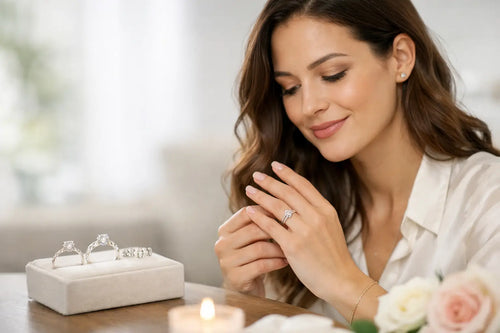
At Henri Carat, D-color, VVS-clarity precision-cut moissanite is selected to create a bright, icy appearance with exceptional light performance. The result is a stone that looks luminous in a sleek solitaire, a romantic halo, or a sculptural three-stone ring.
Durability for Real Life
Engagement rings are not just for photographs. They meet keyboards, grocery bags, celebrations, hand lotion, and the ordinary moments that become your shared life. Durability matters.
Diamond is the hardest known gemstone, measuring 10 on the Mohs scale. Moissanite measures approximately 9.25, placing it among the hardest gemstones available for jewelry. Both are excellent choices for everyday rings when set and cared for properly.
Diamond’s higher hardness gives it a small advantage against surface scratching. Moissanite, however, is exceptionally resistant to scratching and has impressive toughness for regular wear. For the vast majority of couples, it offers lasting beauty without the need to treat their ring like a fragile occasion-only piece.
The setting deserves equal attention. Prongs should be checked periodically, and rings should be removed for heavy lifting, intense workouts, gardening, or harsh chemical cleaning. A beautiful gem lasts longer when the craftsmanship around it is respected.
Price: Where the Decision Changes
The most immediate difference between moissanite and diamond is price. A comparable diamond can cost many times more than a premium moissanite stone of similar visible size. That matters when you want a substantial center stone, a detailed setting, matching wedding bands, or meaningful room in your overall budget.
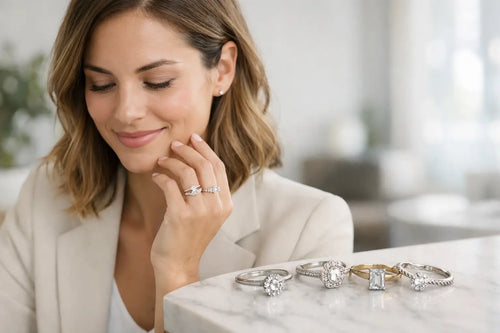
Moissanite changes what is possible. Instead of compromising on finger coverage, shape, or design details to stay within a number, you can choose the oval, emerald, radiant, pear, cushion, or round silhouette that genuinely reflects your style. You may also be able to invest in a more intricate setting or put savings toward a home, honeymoon, future plans, or simply peace of mind.
A lower price does not mean a lesser moment. It can mean you made a considered, confident choice. Looks like a diamond. Priced like a smart decision.
Diamonds do carry a traditional resale narrative, but resale value is often misunderstood. Retail jewelry pricing rarely translates directly to what a buyer can recover later, and factors such as cut quality, certification, market demand, and where the stone was purchased all matter. Buy the ring you want to wear and love, not as a speculative asset.
Ethics and Origin
For couples who care about where their jewelry begins, moissanite offers a clear path. Lab-created moissanite does not require mining, and it is conflict-free by nature. Its controlled creation also allows for consistent color and clarity characteristics.
Natural diamonds have complex supply chains, though responsible sourcing standards and traceability efforts exist across the industry. Lab-grown diamonds provide another alternative for shoppers who want a diamond’s carbon structure without choosing a mined stone. They are still diamonds, but they generally cost less than natural diamonds and more than moissanite in comparable sizes.
Your values may lead the decision here. Some people treasure the geological history and rarity of a natural diamond. Others prefer a stone whose origin aligns more closely with their priorities around budget, sourcing, and modern luxury. Both perspectives are valid.
Do Moissanite Stones Look Like Diamonds?
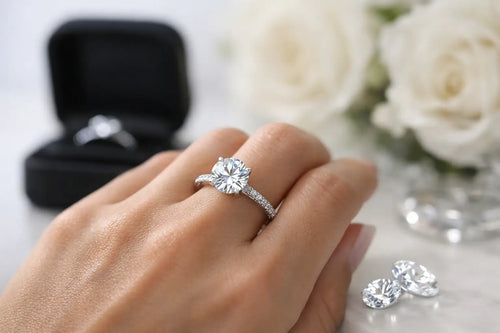
Yes. High-quality moissanite can look remarkably like diamond at a glance, particularly in classic cuts and well-designed settings. Its colorless appearance, high clarity, and brilliant faceting create the polished fine-jewelry look most people expect from an engagement ring.
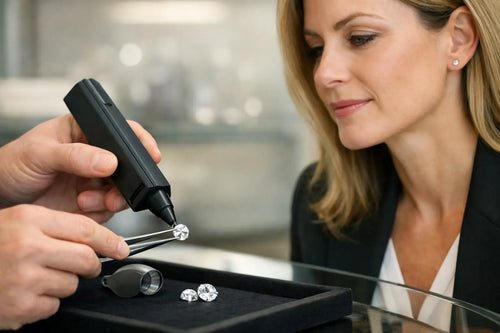
Standard diamond testers commonly respond to moissanite because both stones conduct heat. More advanced testers can distinguish between them, which is why transparency matters. Moissanite should be celebrated for what it is: a distinct, exceptional gemstone with its own brilliance, not a stone that needs to pretend to be something else.
Size can influence perception. In smaller stones, the visual distinction is often subtle. In larger carat-equivalent center stones, moissanite’s colorful fire can be more apparent. If you are choosing a dramatic statement ring, consider whether that vivid sparkle is exactly what you want. For many, it is the reason they fall in love with moissanite.
Which Stone Fits Your Style?
Choose diamond if a natural gem, traditional prestige, and a classic white-light sparkle are central to your vision. It may be worth the added investment when the symbolism of a mined diamond is personally significant and your preferred size and setting fit comfortably within your budget.
Choose moissanite if you want exceptional brilliance, high durability, conflict-free origins, and a luxurious look without conventional diamond markups. It is especially compelling for shoppers who want a larger visual presence, a more expressive shape, or a full bridal look that feels elevated rather than financially restrictive.
There is no rule that says an engagement ring must follow an old formula. The ring you wear should reflect your taste, your standards, and the future you are choosing together. Pick the stone that makes you look down at your hand and think, without hesitation, this is the one.