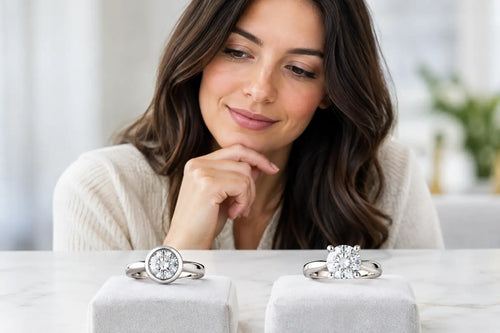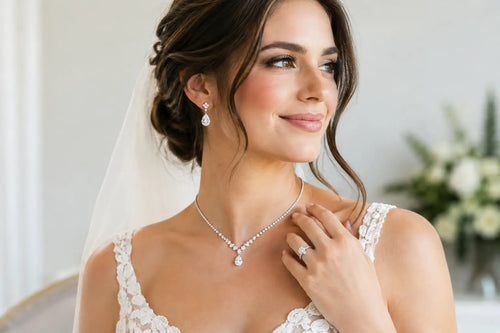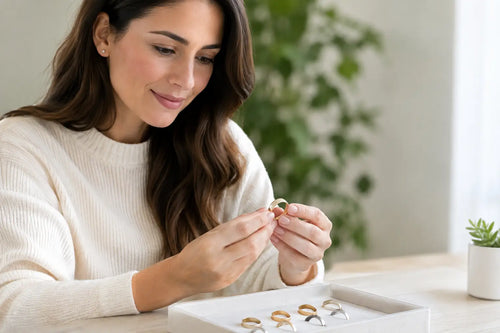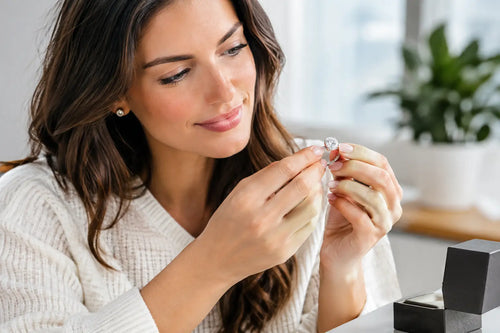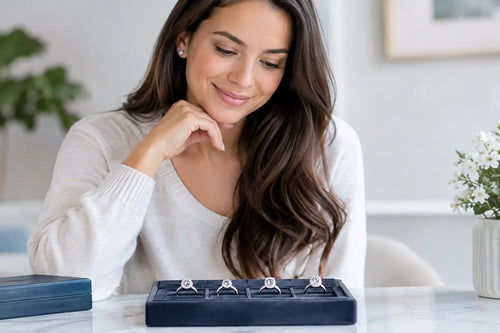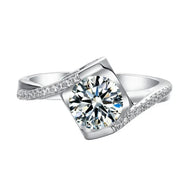

The difference between a ring you admire and a ring you cannot stop looking at often comes down to the setting. When comparing solitaire versus halo rings, you are choosing between two iconic ways to frame a center stone: one lets its beauty stand alone, while the other surrounds it with extra light, scale, and drama.
Both styles can be timeless. Both can feel deeply personal. And with premium D-color, VVS-clarity moissanite, either setting delivers the bright, diamond-like brilliance that makes an engagement ring feel extraordinary. The better choice is not about rules. It is about how you want your ring to look on your hand, wear through real life, and represent your style for years to come.
Solitaire Versus Halo Rings: The Visual Difference
A solitaire ring places all attention on one center stone. Traditionally set on a clean band with four or six prongs, it is defined by restraint. There are no accent stones competing for attention, so the cut, shape, and fire of the center gem become the entire story.
A halo ring adds a close circle of smaller stones around the center stone. That circle may be perfectly round, softly squared, floral, hidden beneath the center gem, or shaped to follow an oval, pear, cushion, or emerald-cut silhouette. The result is a ring with more surface sparkle and a more detailed, high-impact presence.
Neither is inherently more beautiful. A solitaire has confidence in its simplicity. A halo has an immediate, light-catching glamour. Think of the solitaire as a tailored silk dress and the halo as a couture look with luminous embellishment. One is clean and enduring; the other is designed to make an entrance.
Choose a Solitaire for Pure, Center-Stone Brilliance
The solitaire engagement ring has lasted for generations because it gives a beautiful stone room to perform. With moissanite, that matters. Precision-cut moissanite is known for exceptional brilliance and fire, and an open solitaire setting allows light to move through the gem from multiple angles.
This style is especially compelling if you are drawn to a larger center stone, a distinctive shape, or a minimal wardrobe. An oval solitaire can elongate the finger with elegant softness. A round solitaire feels classic and endlessly versatile. Emerald and Asscher cuts bring crisp, architectural sophistication, while a pear or marquise solitaire feels more expressive without needing extra detail.
A solitaire also gives you considerable styling freedom. It can look equally right with a plain wedding band, a pavé band, an eternity ring, or a curved contour band. If you want to mark future anniversaries with additional rings, starting with a clean center-stone silhouette gives you options.
There is a practical advantage, too. Solitaires generally have fewer small stones and fewer intricate edges to clean around. A simple prong setting can make regular at-home care feel straightforward. Of course, prongs should still be checked periodically, particularly if you wear your ring every day.
The trade-off is that a solitaire makes the center stone and its setting highly visible. If you prefer a ring that looks larger across the finger or want more sparkle at every angle, a plain solitaire may feel quieter than you imagined. That can be solved with a slightly wider band, pavé shoulders, a sculptural cathedral setting, or a larger moissanite center stone without leaving the solitaire family.
Who Usually Loves a Solitaire?
Choose a solitaire if you want a ring that feels polished rather than ornate, if the center stone is your priority, or if you like changing your jewelry stack over time. It is also a natural choice for someone who wants a recognizable bridal silhouette that never feels overdone.
Choose a Halo for Maximum Presence
A halo setting is made for those who believe more light is always a good idea. The surrounding stones create a sparkling frame that can make the center stone appear larger, brighter, and more pronounced from a distance. It is a favorite for anyone who wants high-carat visual impact without relying only on the size of the center gem.
The effect varies by shape. A round halo around a round center stone creates a radiant, classic look. An oval halo can emphasize length and create a graceful, elongated outline. A cushion halo delivers soft romance, while a halo around an emerald cut offers striking contrast between clean center facets and glittering pavé detail.
Halos can also change the personality of a ring. A delicate, close-set halo feels refined and feminine. A double halo is bolder and more glamorous. A hidden halo keeps the top view closer to a solitaire but gives the ring a flash of brilliance from the side, making it an appealing middle ground for people who want detail without a fully framed center stone.
For shoppers who love a substantial look, a halo can be an intelligent choice. Moissanite already offers vivid sparkle and a premium, diamond-like appearance. Pairing it with a halo can create a luxurious statement while keeping your budget focused on a design that looks as impressive as it feels.
The consideration is maintenance. Those smaller accent stones create additional places where lotion, soap, and everyday residue can collect. A halo ring benefits from gentle cleaning and careful wear, especially around activities where the setting could take a knock. The intricate construction is part of the beauty, but it deserves the attention you would give any fine piece of jewelry.
Who Usually Loves a Halo?
A halo may be right for you if you gravitate toward glamorous details, want your ring to appear larger on the finger, or wear jewelry that is already expressive and polished. It is a beautiful match for someone who wants their engagement ring to be noticed before they say a word.
Consider Your Lifestyle, Not Just Your Pinterest Board
A ring is photographed for one day and worn for thousands more. Before choosing, picture your usual routine. If you work with your hands, exercise frequently, care for children, or prefer minimal accessories, a lower-profile solitaire may be easier to live with. A bezel solitaire can offer an even sleeker, more protected interpretation of the classic style.
That does not mean halos are impractical. A well-made halo ring can absolutely be an everyday piece. But it is worth choosing a setting height and profile that work for you, rather than selecting only from top-view photos. Look at the side of the ring. Notice whether the band feels delicate or substantial. Consider whether the center stone sits high enough to catch on sweaters or gloves.
Your wedding band matters, too. Many straight solitaires pair easily with a straight band. Depending on its basket and halo shape, a halo engagement ring may sit best with a contoured or notched wedding band. There is no wrong pairing, but trying the silhouettes together mentally before you choose can save you from surprises later.
Budget and Value: Where Should the Attention Go?
With a solitaire, more of the visual budget typically goes toward the center stone. This is ideal when you want a larger moissanite, a particular shape, or a cut that has exceptional presence. Because moissanite delivers striking fire at a more accessible price than traditional mined diamonds, a solitaire can look remarkably elevated without conventional diamond markups.
With a halo, the visual impact is distributed. The center stone remains the focus, but the surrounding accent stones add dimension and give the entire ring a larger footprint. This makes halo designs particularly appealing if you love the look of a grand, luminous ring and want to spend strategically.
The smartest decision is not automatically the least expensive option or the biggest stone. It is the ring that gives you the feeling you want every time you reach for it. At Henri Carat, that means choosing brilliance without compromise: exceptional sparkle, refined craftsmanship, and a design that looks like your love story rather than someone else’s.
The Best Shapes for Each Setting
Almost every stone shape works in either style, but each setting highlights different features. Round, oval, cushion, and pear shapes are natural favorites for halos because the surrounding stones echo their outlines beautifully. Ovals are especially popular for their finger-lengthening effect, while pear halos can feel romantic and distinctive.
Solitaires are equally adaptable, though they are often the strongest choice for shapes with character of their own. Emerald, radiant, marquise, Asscher, and princess cuts can shine in a minimal setting because their geometry remains crisp and unmistakable. A solitaire also lets you appreciate the shape of a heart-cut stone without any distraction around its edges.
If you cannot decide, consider a hidden halo. It preserves the clean face-up view of a solitaire while adding a private flash of pavé sparkle beneath the center stone. It is a modern detail that rewards a closer look.
Let Your Everyday Style Make the Decision
Your engagement ring does not need to fit a trend, a friend’s preference, or a category label. A solitaire is for the person who sees beauty in a single exceptional stone. A halo is for the person who wants every glance to catch the light. Both are timeless when they feel true to you.
Try to imagine the ring in ordinary moments: holding a coffee cup, signing your name, reaching for your partner’s hand, or seeing it sparkle in late-afternoon light. The setting that still makes you smile in that picture is the one worth choosing.